
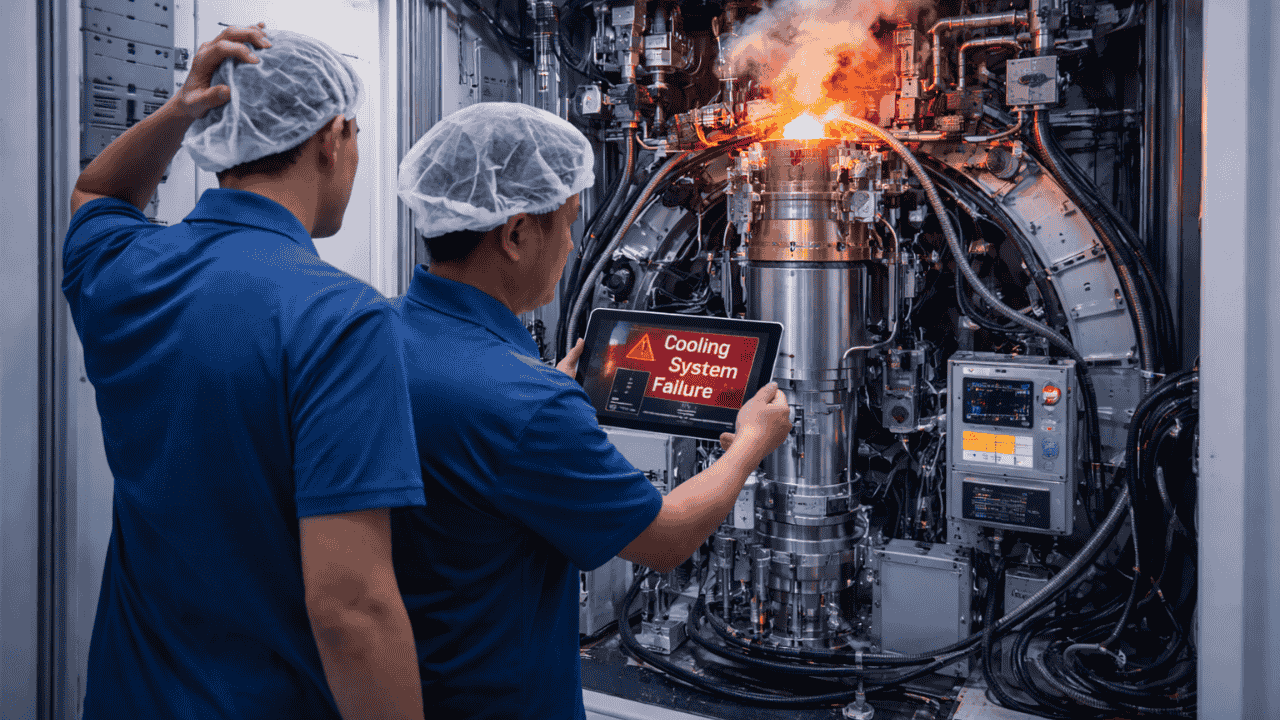
Six Months Later the Cooling System Started Failing.
If you spend enough time around mechanical rooms, patterns start to emerge.
One of them is this:
Cooling failures often start with a pump selection that looked perfectly reasonable on paper.
The pump meets the design flow. The head calculation checks out. The specification is satisfied.
And yet the system behaves strangely once the facility goes into real operation.
Flows fluctuate. Control valves hunt. Temperatures drift. Chillers cycle more than expected.
Eventually someone says the words every facility team has heard before:
“The system worked fine during commissioning.”
Then August arrives.
The Hidden Problem With Pump Sizing
In many cooling systems, pump sizing is treated as a straightforward hydraulic exercise.
Calculate the flow. Estimate the head. Select the pump.
From a specification standpoint, the job is done.
But mission-critical cooling systems rarely behave like the simple calculations used to design them.
Real systems include:
• variable flow control valves • equipment staging • seasonal load changes • partial load operation • changing heat rejection conditions • control system interactions
In other words:
The pump rarely operates where the design calculation assumed it would.
That’s where problems begin.
A Real-World Scenario
A semiconductor test facility once experienced recurring temperature instability across multiple test stations.
The chillers were blamed first.
Then the control system.
Then the heat exchangers.
The system had plenty of cooling capacity. On paper, everything was sized correctly.
The real issue turned out to be the distribution pumps.
They had been selected for peak flow with generous safety margin.
At part load, which represented most of the facility’s operating life, the pumps were operating far off their efficiency range.
The result?
Excessive differential pressure across control valves.
The valves were forced into extremely small positions to maintain flow.
Small valve movements created large flow changes.
Control loops became unstable.
The cooling system was technically “meeting spec.”
But the facility was constantly fighting temperature drift.
In semiconductor testing, that kind of instability can disrupt entire test sequences.
Why Engineers Miss This Problem
Pump sizing errors rarely look like errors during design.
The calculations are correct.
The specifications are met.
The equipment schedules look clean.
But several industry habits quietly create risk.
1. Oversizing for Safety
Engineers often add safety margins to flow and head calculations.
On paper, this seems prudent.
In practice, excessive margin can push pumps into operating regions that create unstable system behavior.
2. Designing Around Peak Load
Most systems are sized for maximum conditions.
But many facilities operate at partial load for the majority of the year.
A pump that behaves well at peak conditions may behave poorly during normal operation.
3. Ignoring Control Valve Authority
Pump sizing directly affects control valve performance.
When differential pressure is too high, valves lose authority.
Small movements produce large flow changes.
That’s when systems start hunting.
4. Simplified System Curves
Many design calculations assume static piping conditions.
Real systems are dynamic.
Valves open and close. Equipment stages on and off. Heat loads shift.
The system curve constantly moves.
The Operational Consequences
Pump sizing problems rarely appear as obvious equipment failures.
Instead, they create symptoms that confuse operations teams.
You may see:
• unstable temperature control • excessive pump energy consumption • noisy control valves • frequent chiller cycling • difficulty balancing the system • uneven cooling across loads
In mission-critical environments, those symptoms can lead to serious consequences.
A research laboratory may lose experiments.
A semiconductor test facility may lose production time.
A hospital imaging center may cancel patient scans.
The cooling system still “works.”
But reliability quietly degrades.
What Smart Facilities Do Differently
Experienced facilities teams eventually recognize that pump selection is not just about meeting design flow.
It’s about ensuring stable operation across the full range of system behavior.
That means asking deeper questions during design:
• Where will the pump operate at part load? • How will valve authority change during staging? • What happens to differential pressure during low-load conditions? • How will system curves shift as equipment cycles?
In high-reliability facilities, engineers increasingly look at:
• pump operating envelopes • control valve authority • dynamic system behavior • staged equipment operation
Those factors determine whether a cooling system behaves predictably—or becomes difficult to control.
A Quiet Truth About Cooling Systems
Cooling capacity is relatively easy to design.
Cooling stability is harder.
Many systems meet specification yet still struggle during real operation.
And pump selection is often one of the quiet design decisions that determines whether a system runs smoothly for years—or becomes a constant source of operational headaches.
Because in mission-critical facilities, the question isn’t simply:
“Does the system meet the design flow?”
The real question is:
“Will the system remain stable under real operating conditions?”
Martin P. King works with facilities and engineering teams to uncover hidden reliability risks in mission-critical cooling infrastructure.
