
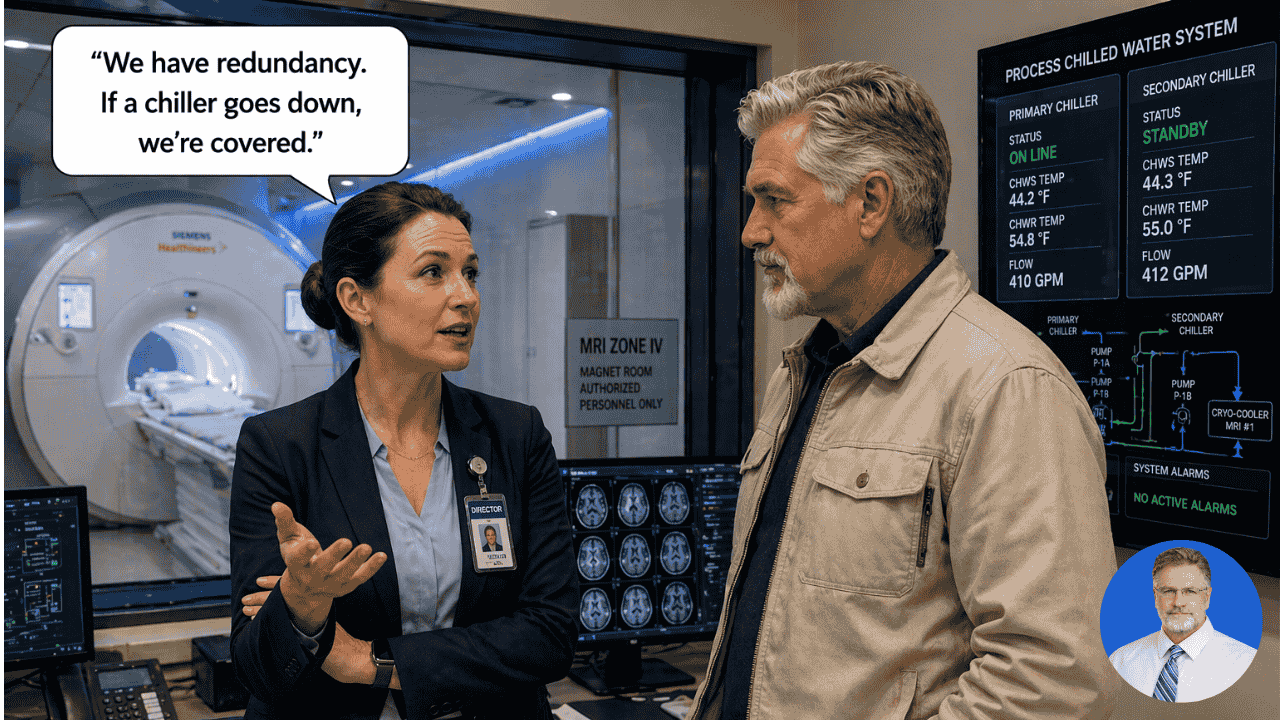
A Director of Imaging for a major health system once told me:
“We’ve got redundancy. If a chiller goes down, we’re covered.”
They weren’t.
Because in MRI and CT environments, a chiller failure isn’t just an HVAC event.
It’s a time-sensitive stability problem.
And most facilities don’t realize how little margin they actually have.
The Reality Most Teams Underestimate
MRI systems rely on cryogenic cooling to maintain superconductivity.
That superconducting magnet is typically sitting in a liquid helium environment supported by a cryo-cooler.
That cryo-cooler depends on continuous, stable chilled water.
When that water goes unstable—or disappears—the system doesn’t fail instantly.
But it starts moving in one direction:
Toward loss of thermal control.
What Actually Happens When the Chiller Goes Down
It’s not just “loss of cooling.”
It’s a chain reaction:
- Chilled water flow stops or destabilizes
Even short interruptions can disrupt the cryo-cooler heat removal process. - Cryo-cooler performance degrades
It can’t reject heat effectively without stable condenser-side conditions. - Magnet temperature begins to rise (slowly)
Not immediately visible. But the margin is shrinking. - System alarms escalate
First minor. Then critical. - Protective shutdown or quench risk increases
This is where things get expensive.
The Part That Makes This Dangerous
There’s often a false sense of time buffer.
Teams assume:
“We have backup systems. We’ll recover quickly.”
But here’s what actually matters:
• How fast backup cooling engages
• Whether flow remains uninterrupted
• Whether temperature stability is maintained during transition
Because MRI systems don’t respond well to transients.
Even brief instability can trigger faults or force shutdown sequences.
Real-World Failure Pattern
A common scenario looks like this:
Primary chiller trips.
Backup chiller starts—but not instantly.
During that transition:
• flow drops
• temperature spikes slightly
• control valves react aggressively
• system overshoots trying to recover
From a building perspective, this is minor.
From an MRI perspective, it’s a disturbance.
Enough of those disturbances…
And the system protects itself.
Why CT Systems Aren’t Immune Either
CT scanners don’t use superconducting magnets.
But they still rely on tight thermal control for:
• X-ray tube cooling
• power electronics
• detector stability
When chilled water fails:
• tube temperatures rise quickly
• system derates or shuts down
• scan quality can degrade before shutdown
In high-throughput environments, even short interruptions mean:
• delayed patient schedules
• rescan requirements
• lost revenue per hour
The Operational Pain Points Hospitals Actually Feel
This is where the conversation usually shifts.
Because once a cooling-related shutdown happens, the impact is immediate:
• Cancelled scans — patients rescheduled, sometimes days out
• Lost revenue — MRI systems can generate thousands per hour
• Clinical disruption — emergency diagnostics delayed
• Vendor callouts — expensive, time-consuming, often inconclusive
• Staff frustration — no clear root cause, recurring issues
And the most frustrating part?
The imaging system gets blamed first.
The Expensive Scenario No One Wants
Worst case isn’t just a shutdown.
It’s a magnet quench.
That’s when the superconducting magnet loses its state and rapidly boils off helium.
Consequences:
• helium loss (expensive and increasingly difficult to source)
• system downtime (days to weeks)
• potential room safety concerns (oxygen displacement if venting fails)
• major operational disruption
And while not every cooling failure leads to a quench…
Cooling instability is one of the pathways that can contribute to it.
Why Redundancy Often Fails in Practice
On paper, systems look protected:
• N+1 chillers
• backup pumps
• emergency power
But reliability isn’t about having backups.
It’s about how the system behaves during transition.
Common gaps:
• delayed failover sequences
• poor control integration between units
• flow interruptions during switchover
• unstable temperature recovery
So yes—backup exists.
But the MRI experiences instability anyway.
The Subtle Warning Signs Before a Major Event
Most facilities get signals before a serious incident:
• brief imaging interruptions during plant events
• alarms that clear without clear cause
• seasonal sensitivity (issues during hotter months)
• operators “helping” the system during transitions
These aren’t random.
They’re previews.
What Experienced Facilities Start Focusing On
The mindset shift is subtle—but critical.
Instead of asking:
“Do we have backup cooling?”
They ask:
“Can our system transition without the MRI ever noticing?”
That’s a much higher standard.
And it’s where most systems fall short.
The Quiet Reality
When a chiller goes down in an imaging facility…
You’re not troubleshooting HVAC.
You’re racing a stability problem with real clinical consequences.
Closing Thought
If your facility has ever experienced:
• scan interruptions during plant events
• unexplained imaging faults
• seasonal performance changes
• reliance on operator intervention
There’s a good chance your system isn’t as resilient as it looks.
Most aren’t.
They just haven’t been tested the hard way yet.
Martin P. King works with hospitals and imaging facilities to uncover hidden reliability risks in mission-critical cooling systems supporting MRI and CT infrastructure.
