
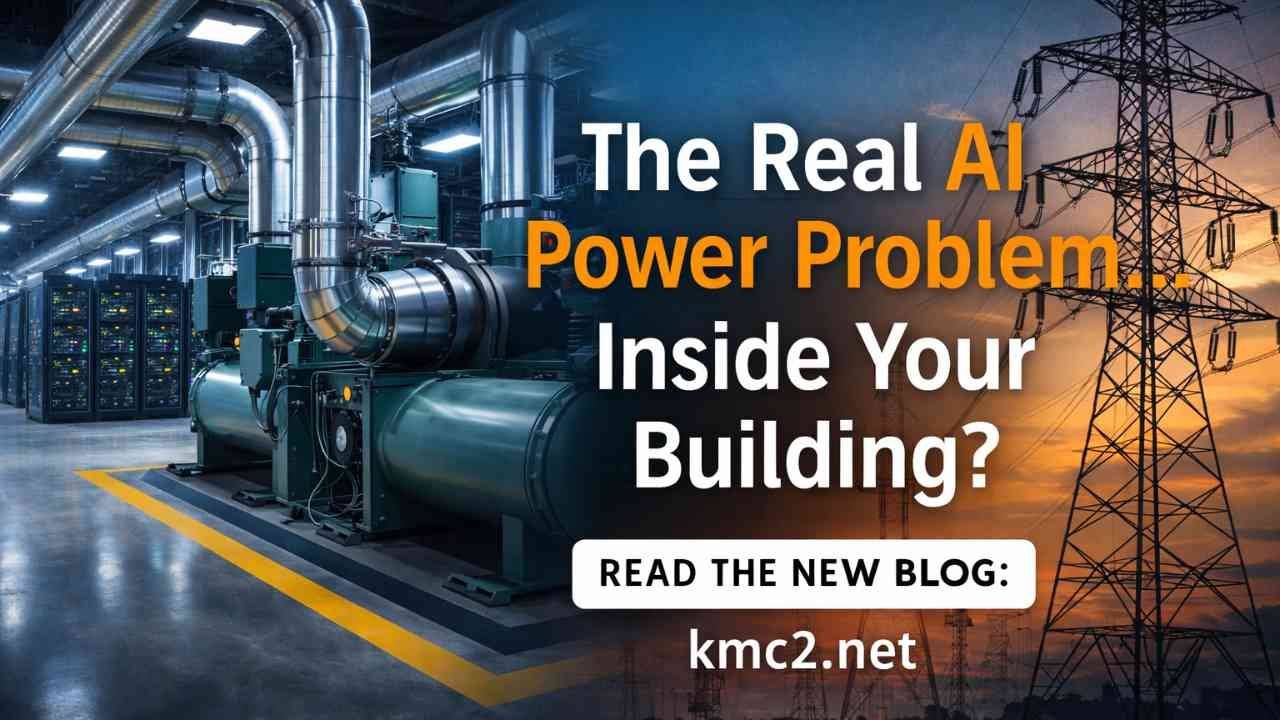
Why legacy mechanical systems—not just transmission limits—are becoming the next bottleneck in AI infrastructure
Everyone Is Looking at the Grid
Everyone is talking about the grid.
That makes sense. The numbers are hard to ignore. The U.S. Department of Energy said in late 2024 that data center electricity consumption could double or triple by 2028, rising from roughly 4.4% of U.S. electricity use in 2023 to somewhere between 6.7% and 12% by 2028.
At the same time, the North American Electric Reliability Corporation is projecting 224 GW of summer peak demand growth over the next decade, with large data centers playing a meaningful role.
So the industry conversation has gone exactly where you would expect.
More generation.
More transmission.
Faster interconnection.
Organizations like PJM Interconnection and Electric Reliability Council of Texas are already adapting—introducing concepts like staged energization, curtailment frameworks, and in some cases requiring large loads to bring their own generation.
All of that matters.
But it’s not the whole story.
The Constraint Has Quietly Moved Inside the Building
In many cases, the power will reach the facility.
The real bottleneck shows up after that.
Inside the cooling plant.
Traditional data center infrastructure was built around a different operating reality. Load profiles were relatively stable. Ramps were gradual. Systems were designed to settle into predictable steady-state operation.
That stability shaped everything:
-
chilled-water plant design
-
pump sequencing
-
valve control strategies
-
air-side performance
For years, that model worked.
Now it’s being challenged.
AI Didn’t Just Increase Load. It Changed Behavior
AI is often described as “high density.”
That’s true—but incomplete.
What’s changing just as much is how load behaves.
Large GPU clusters can move in synchronized steps. Training jobs can create sharp swings in power and heat rejection. Inference environments may be more distributed, but they still introduce faster, less predictable shifts than traditional enterprise workloads.
The important distinction is this:
Cooling systems don’t respond to average load.
They respond to change.
And that change is happening faster than many legacy systems were designed to handle.
Where the Grid Story Meets the Mechanical Room
This is where the conversation gets more interesting.
Grid operators are no longer just asking whether they can supply power. They’re defining how that power is delivered:
-
staged energization
-
ramp-rate limits
-
curtailment windows
-
backup-generation expectations
From the grid’s perspective, this preserves reliability.
Inside the facility, it introduces something else entirely.
Operating conditions that many cooling systems were never designed—or tested—to handle.
When you combine AI-driven load behavior with grid-driven constraints, the system is no longer operating in the environment it was built for.
Where Instability Actually Shows Up
Systems rarely fail at full load.
They struggle when things start to move.
Consider a large GPU cluster dropping 15 MW in under a minute during a training checkpoint. The chilled-water system sees a rapid shift in return-water temperature. Delta-T begins to collapse. Chillers unload unevenly while control valves start chasing new setpoints.
At the same time, pumping energy rises—even though useful cooling efficiency is dropping.
Or take a pump failover.
On paper, the redundancy is there. In practice, the transition can introduce a brief pressure spike or oscillation. Flow through the system becomes unstable. Control loops begin interacting. One part of the plant overcompensates while another lags behind.
The system stabilizes eventually.
But not before performance degrades.
These are not catastrophic failures.
They are short-duration, repeatable instabilities. Easy to miss. Difficult to diagnose. And increasingly common under real operating conditions.
Inefficiency Is Now Lost Compute Capacity
In the past, inefficiency was mostly a cost problem.
Now it’s something more serious.
It’s lost capacity.
When delta-T collapses, when pumps move more water than necessary, when control instability forces conservative operation, the system consumes more power than it should.
That power isn’t available for compute.
Facilities that appear to have available capacity on paper often struggle to deploy it effectively in practice. Not because the grid can’t supply the power—but because the system inside the building can’t use it efficiently or predictably.
The Assumption That No Longer Holds
For years, reliability has been tied to design.
If the system met specification, included redundancy, and passed commissioning, it was considered ready.
But that validation typically happens at steady-state conditions.
The real world doesn’t operate there.
Redundancy is proven at full load.
Risk shows up during transitions.
That’s where systems reveal how they actually behave—not how they were intended to behave.
A Different Standard for Reliability
The definition of reliability is shifting.
It’s no longer enough to confirm that a system can meet design conditions.
The real question is:
How does it behave across the full operating envelope?
That includes:
-
partial load operation
-
rapid load changes
-
failover events
-
asymmetric demand conditions
-
utility-driven curtailment scenarios
Facilities that are getting ahead of this are doing something different.
They’re not just verifying design.
They’re validating behavior.
Through deeper trend analysis, dynamic modeling, and controlled testing, they’re identifying where instability begins—and addressing it before it becomes a constraint.
Closing Thought
The industry is right to focus on how to power AI.
But the next constraint may not be whether power reaches the site.
It may be whether the systems inside the building can turn that power into stable, reliable, high-density compute.
The grid is under pressure.
But in many facilities, the first signs of strain will show up somewhere quieter.
Inside the mechanical room.
Martin P. King works with engineering and facility teams to uncover hidden instability and reliability risks in mission-critical cooling infrastructure—especially under real-world operating conditions that design documents rarely capture.
